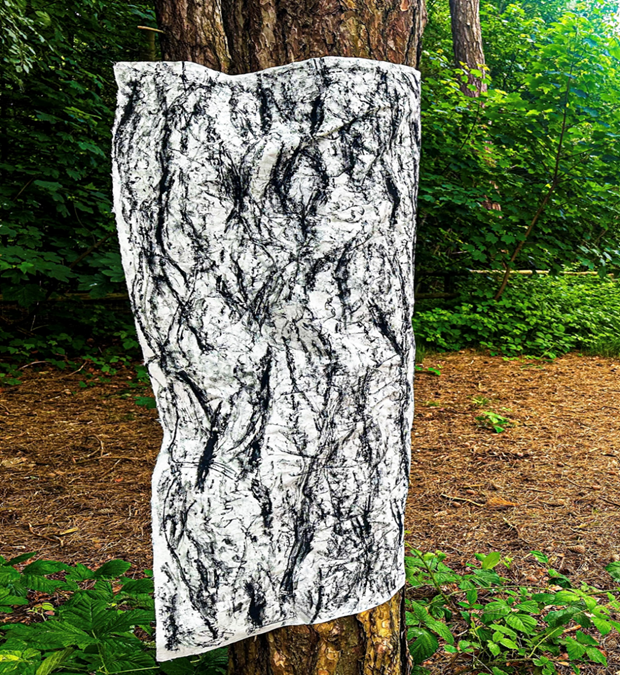
mulberry paper
wrapped around pine bark—
the wind draws with me
— Varsha Manglam, Formby Forest field notes
The Song of Earth emerged from time spent in nature, where being among trees and birdsong became a mindful and embodied experience. Spending time outdoors heightened my awareness of the rhythms, textures, and movements of the natural environment, and these encounters became central to the development of the work.
Conceived as an immersive and performative installation, The Song of Earth invites viewers to slow down and engage sensorially with their surroundings. Rather than representing nature, the work seeks to evoke the experience of being within it, creating space for reflection on our relationship with the natural world and the importance of its care.
The installation brings together drawing, sound, movement, and audience interaction. Viewer movement activates subtle shifts in sound and motion, creating a responsive environment in which participation becomes part of the work itself. I was interested in exploring how interaction could generate a more embodied encounter between audience, space, and environment.
Mulberry paper became central to the project because of its dual quality of fragility and strength. As a handmade and translucent material, it allowed for layered mark-making while remaining responsive to air, touch, and environmental conditions. Its sensitivity made it particularly suited to working outdoors and engaging directly with environmental processes.
The charcoal drawings were produced in Formby Forest by wrapping long sheets of mulberry paper around tree trunks and allowing the bark to guide the marks. Through both gentle and forceful gestures, the paper recorded traces of the trees, transforming the drawings into material imprints of bodily movement and environmental encounter. In this process, the environment became an active participant in shaping the work.
Looking back, The Song of Earth marked an important stage in my ongoing engagement with ecocentric practices, environmentally responsive materials, and site-specific processes. It also reinforced an approach that continues to inform my research and artistic practice: understanding nature not simply as a subject of representation, but as an active collaborator.