
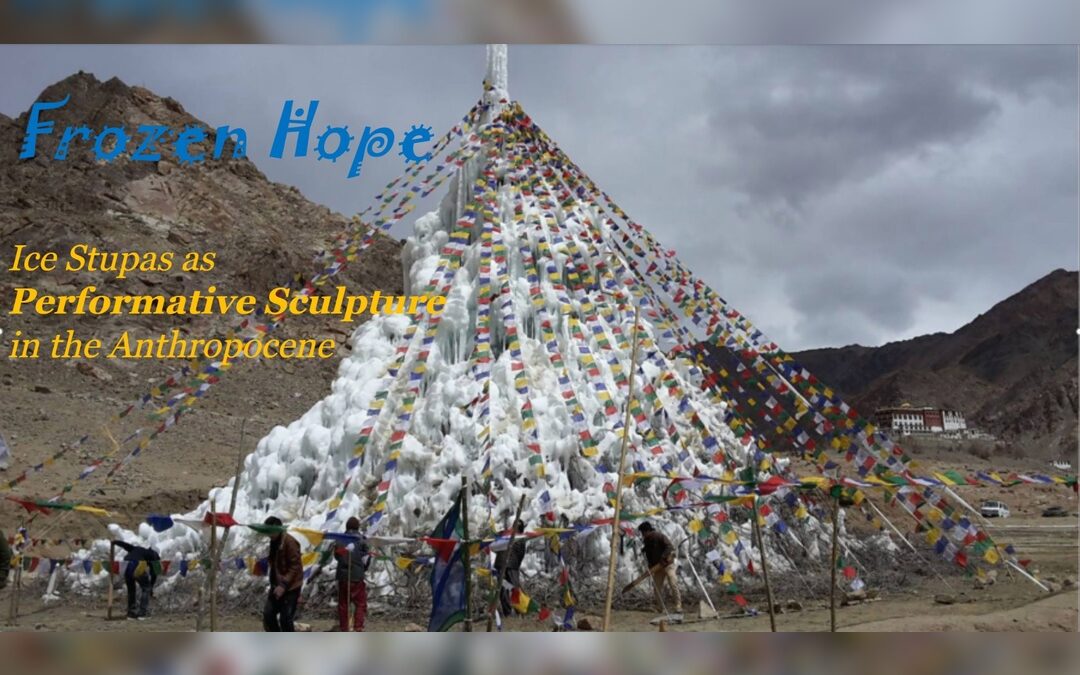
Above Image: Ice Stupa Artificial Glacier Project
What if the weirdest water of the Anthropocene is frozen in the desert as an Ice Stupa, a structure that stands simultaneously as salvation and warning?
In Ladakh, glaciers are being rebuilt by hand.
Towering cones of ice rise from the cold desert like frozen monuments; temporary glaciers engineered to store winter stream water in order to survive spring droughts. Designed by environmental innovator Sonam Wangchuk, these Ice Stupas exist somewhere between infrastructure, ritual, and sculpture. The more I read about them, the more they began to feel less like technological objects and more like performative acts of survival.
An engineered glacier. Ice shaped into architecture. A spiritual monument made from meltwater. It embodies the paradox of our era: a creative adaptation to climate change and at the same time a stark reminder of the environmental disruption that makes such innovation necessary in the first place.
As an artist, I am interested in the Ice Stupa not only as ecological technology but as performative sculpture. There is something profoundly theatrical about it. Ice is staged into form, climate becomes choreography, and survival itself becomes a collective performance enacted against the backdrop of ecological instability.
Visually echoing Buddhist stupas and emerging from the barren cold desert landscape, these ephemeral structures stand as both climate-adaptive innovations and monumental artworks of ice. They grow, transform, melt, disappear. Their temporary nature is central to their meaning. The Ice Stupa performs the instability of the Anthropocene while simultaneously resisting it.
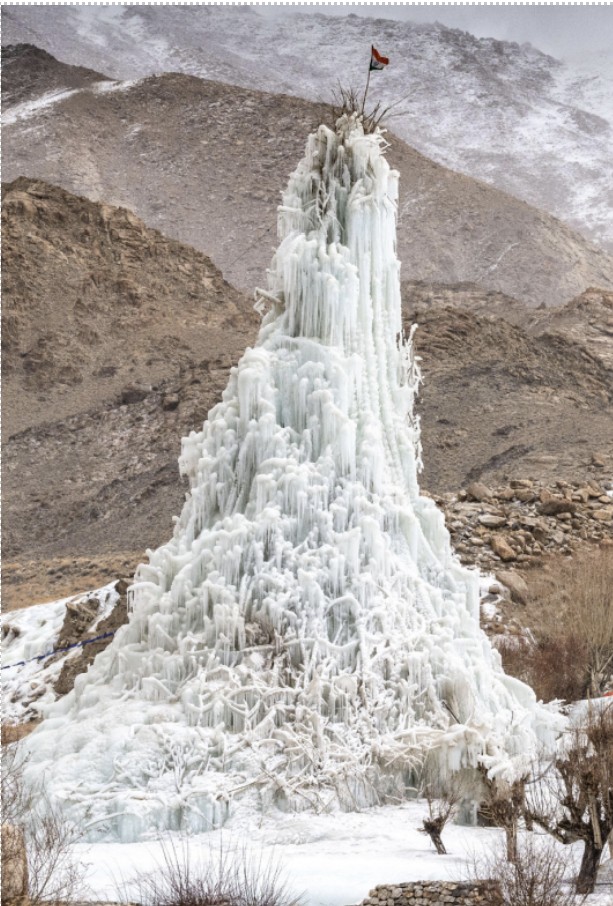
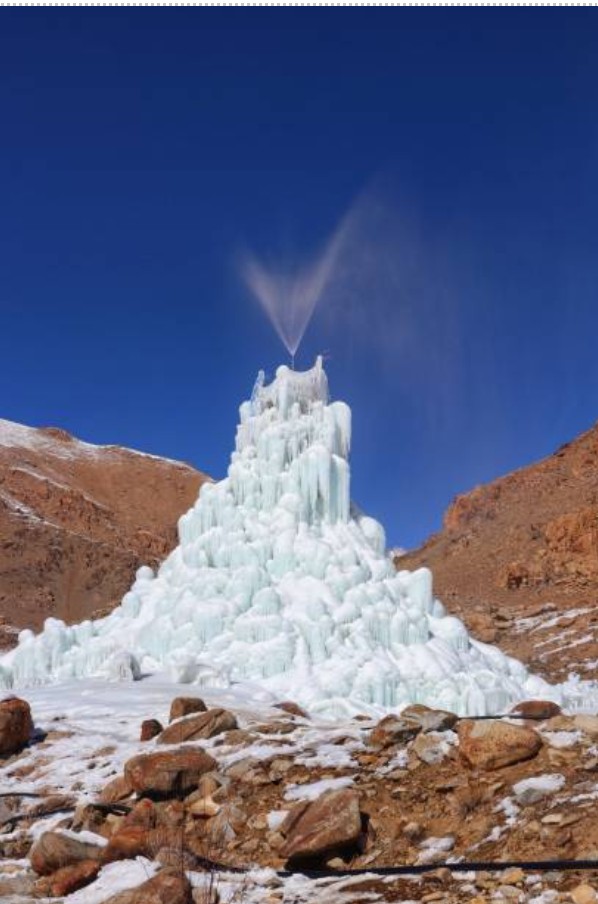
Above Images: Ice Stupa Artificial Glacier Project
“If you cannot stop it, adapt to it.”
This is the mantra of a tiny village situated among the breathtaking Himalayan desert mountains of Ladakh in the extreme north of India. I came across this line while reading about Ice Stupas, and it stayed with me because it captures something both hopeful and deeply unsettling about climate adaptation in the Anthropocene.
What fascinates me most is the way these structures refuse categorisation. They are practical yet symbolic, sacred yet engineered, speculative yet materially grounded. The Ice Stupa blurs boundaries between utility and symbolism, art and infrastructure, spirituality and environmental crisis. It becomes difficult to know whether one is looking at a machine, a monument, or a warning.
This is where the idea of “weird water” becomes important to me.
Within blue humanities discourse, water is often imagined through oceans, tides, and coastlines. But the Ice Stupa asks us to think differently - toward inland cryospheres, glacial melt, and high-altitude hydrological worlds. Drawing on Astrida Neimanis’s notion of the hydrocommons and Elizabeth DeLoughrey’s oceanic imaginaries, I see the Ice Stupa as a storied and agentive form of water: a body that carries ecological memory, spiritual symbolism, and political urgency all at once.
The more I think about the Ice Stupa, the less it feels like an object and the more it feels relational. Through the work of posthumanist and new materialist thinkers such as Rosi Braidotti, Karen Barad, and Jane Bennett, the Ice Stupa begins to appear as something far more entangled than a human-made structure. It emerges through glacial systems, labour, gravity, temperature, ritual, communities, and climate instability. Human and nonhuman forces co-produce it. The Ice Stupa becomes an assemblage of mutual survival.
I am drawn to the strange emotional contradiction at the centre of these frozen structures. They are hopeful, but their existence is also evidence of loss. They are beautiful because something has already gone wrong.
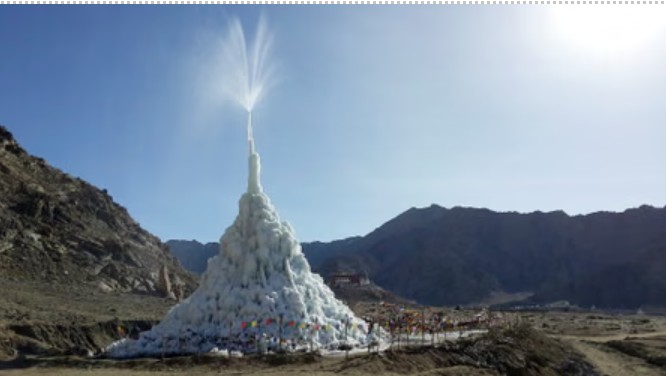
Above Image: Ice Stupa Artificial Glacier Project
Standing in the desert, the Ice Stupa becomes an icon of frozen hope.
What interests me most is that these structures stage glacial melt not only as environmental catastrophe but also as a site of speculative ecological possibility. They imagine futures. They perform survival. They ask us to rethink water not as passive matter or resource, but as a living, world-making force capable of shaping relationships between humans and more-than-human worlds.
The Ice Stupa therefore operates simultaneously as infrastructure and image, adaptation and warning, sculpture and survival mechanism. It offers a high-altitude hydrological imaginary rooted in Ladakh’s environmental realities while inviting broader questions about how we might live with water differently in an age of ecological uncertainty.
By centring the Ice Stupa as a weird, inland, and speculative water-being, I want to think about how these hydrological interventions are not merely functional responses to climate change but also narrative and ontological acts. They imagine futures into existence. They perform new modes of relation. They reveal survival itself as something aesthetic, collective, and deeply political.
The Ice Stupa exists only for a season, yet within that brief existence it holds together crisis, adaptation, spirituality, beauty, and survival all at once.