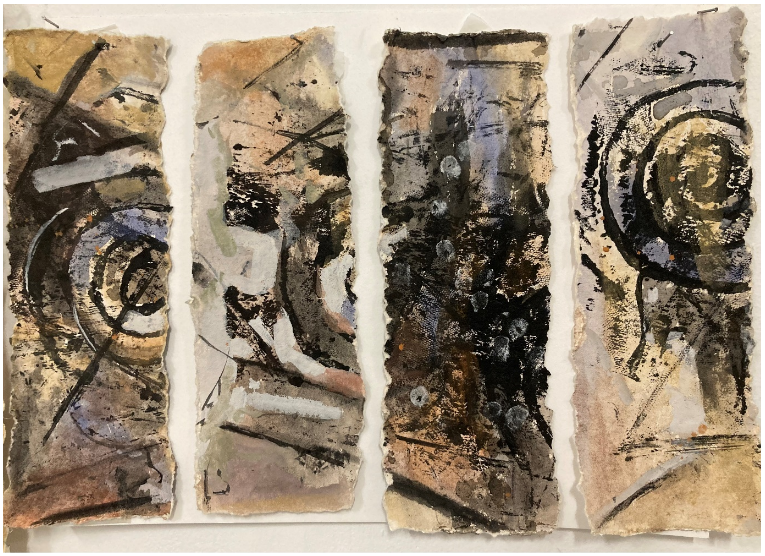
Above - Monoprint using earth based pigments, by Varsha Manglam, 2022
Brian Fay’s essay “A Continuous Incompleteness”, published in What Is Drawing? by the Irish Museum of Modern Art, offers a thoughtful and wide-ranging way of thinking about drawing.
Fay, both an artist and Senior Lecturer in Fine Art at Technological University Dublin, approaches drawing not as something fixed or easily defined, but as a medium that is constantly changing. He argues that drawing has moved from being seen as a “minor support medium” to becoming an independent form of art in its own right. According to Fay, this change can be understood through four qualities that belong to drawing: intermediacy, contingency, uniqueness and what he calls “continuous incompleteness”.
What I find particularly interesting is that Fay does not begin with materials or techniques. Rather than asking whether drawing is made with pencil, charcoal, ink or digital tools, he asks what drawing is trying to do.
For Fay, the important thing is not the medium itself, but the intention behind it.
Instead of concentrating on the process or the materials used, he suggests that we should think about the content of a drawing and the intentions of the person making it. This seems to me a much more useful way of understanding drawing, because it moves away from endless debates about methods and focuses instead on meaning.
This approach also reflects the way many contemporary artists think about drawing. As Davies writes:
“My approach to drawing is two fold. Firstly, to use it as a tool to get out and examine the stuff of the world, to gather information and record experience. Secondly, as a means to construct narratives which communicate what I think and feel.”
This idea of drawing as both observation and narration feels particularly important. Drawing is not simply a record of what is seen. It is also a way of communicating thoughts, feelings and experiences.
One example that illustrates this is Davies’ drawing of the effects of global warming, in which familiar objects are shown half-buried in silt after a flood. The image is simple, yet it communicates the devastating consequences of climate change more powerfully than a written explanation.
Fay also argues that drawing is never static. It changes continuously and adapts to new forms, technologies and ways of thinking. As he writes, “drawing is an activity that is continuously mutable, constantly adapting to new forms, emerging technologies and conceptual attitudes.”
This seems difficult to disagree with.
Drawing has always changed alongside human civilisation. From Egyptian hieroglyphs, which can be seen as one of the earliest forms of visual language, to contemporary digital drawing, the medium has constantly evolved.
For many centuries, however, drawing was regarded as secondary. It was often seen only as a preparatory stage in the making of paintings, sculpture or architecture. In this understanding, drawing existed not for itself, but for something that would come later.
As Fay writes, drawing “functions as an anticipatory, in-between stage that is solution-oriented, not for itself but for a future artwork.”
There are many examples of this. Artists such as Leonardo da Vinci and Rembrandt filled sketchbooks with drawings that allowed them to record observations, test compositions and develop ideas. These drawings were often private and unfinished, yet they formed an essential part of the creative process.
At the same time, I think Fay’s essay has one important limitation.
He concentrates mainly on the Western tradition of art. Although this provides a clear framework, it risks making drawing appear more limited than it really is.
Drawing is not only a Western phenomenon. It appears in many cultures and traditions, from Chinese calligraphic scrolls to Māori ancestral tattooing. It is difficult to imagine that drawing belongs to one place or one culture alone. As soon as people began to make marks in order to describe, remember or communicate, drawing began.
Drawing also exists far beyond the world of art.
Fay argues that drawing “does not solely belong to visual art”, and this seems especially true. Drawings appear in science, industry, education and everyday life.
One of the earliest examples is Georg Ehret’s botanical drawing of the Linnaean plant system. The drawing was made not as a work of art, but as a way of explaining a complex scientific process. It shows that drawing can be used as a form of knowledge as well as a form of expression.
In this sense, drawing is both practical and imaginative.
Fay’s discussion becomes especially interesting when he considers the relationship between drawing and invention. For a long time, drawing was judged according to ideas of skill or what was considered a “good drawing”. Fay suggests something different.
From the late fifteenth century onwards, he argues, drawing became closely connected with invention and with the creation of ideas.
This seems particularly relevant today, when originality is often valued more highly than technical perfection. A drawing does not need to be finished or polished in order to matter. Sometimes its power lies precisely in its openness, its uncertainty, or its incompleteness.
Fay refers to works such as Marcel Duchamp’s L.H.O.O.Q., Robert Rauschenberg’s Erased De Kooning Drawing and Brian O’Doherty’s Drawing for Marcel Duchamp. These works challenge the traditional idea of drawing and suggest that drawing can exist as a concept, a gesture or even an absence.
At the same time, drawing can also be understood as a form of visual narration. It often represents something that already exists in the artist’s mind before it appears on paper.
For this reason, drawing should not be seen simply as a by-product of art-making or as something incomplete in a negative sense. Its incompleteness may instead be one of its greatest strengths.
The rise of digital technology has made this even clearer. In a world filled with endless reproduction, copying and repetition, drawing still retains a sense of uniqueness. It carries the trace of the person who made it.
As Fay writes, drawing is “an unmediated carrier for direct forms of emotional or subjective inquiry.”
Perhaps this is why drawing continues to matter.
Even now, when images can be endlessly reproduced and altered, a drawing still feels immediate and personal. It retains something of the hand, the thought and the moment from which it came.
Brian Fay’s essay offers a valuable way of understanding this. Rather than defining drawing too narrowly, he allows it to remain open, changing and unfinished.
And perhaps that is exactly what drawing has always been.
References
- Davies, C. (2017). Statement on drawing.
- Fay, B. (2013). “A Continuous Incompleteness.” In What Is Drawing? Irish Museum of Modern Art.
- Irish Museum of Modern Art. What Is Drawing?
- Relevant images: Marcel Duchamp, L.H.O.O.Q. (1919); Robert Rauschenberg, Erased De Kooning Drawing (1953); Brian O’Doherty, Drawing for Marcel Duchamp (1967).